90s internet: dial-up, personal websites, chat and games
Published
Explore the 90s internet through five activities: connecting by dial-up, browsing websites, publishing a homepage, chatting and playing games. The links below lead to the relevant histories, surviving sites and current ways to try them.
On this page
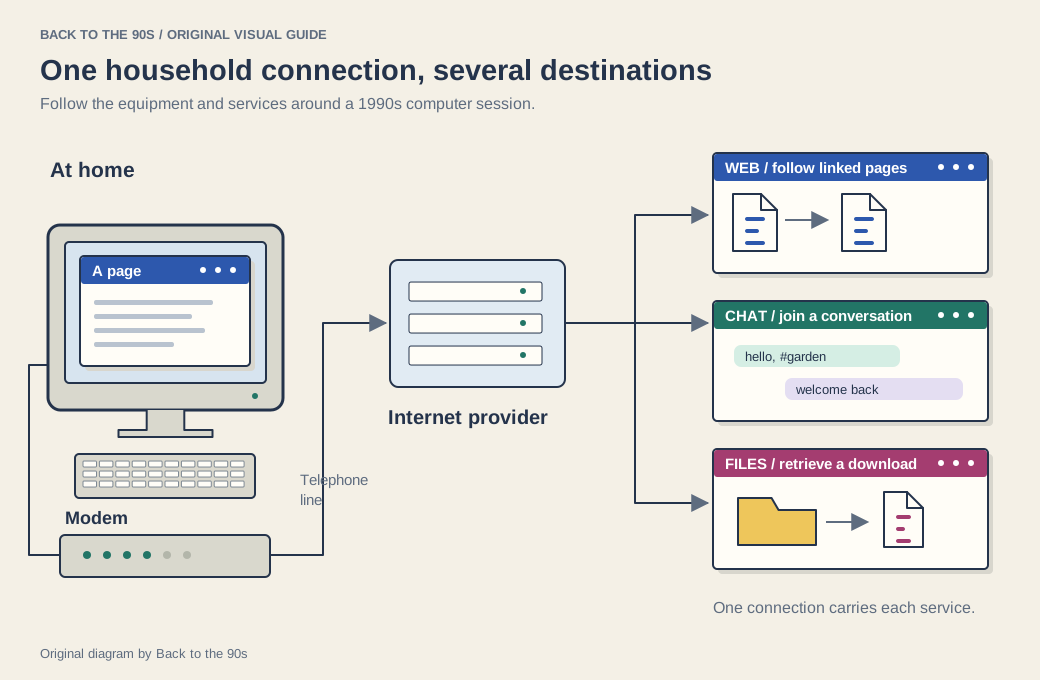
A modem connects the household to a provider. The connection carries several kinds of internet activity.
Choose a route through the decade
For the web’s beginnings, start with CERN’s 1990 server and project page. For a mid-decade browsing session, pair Navigator’s December 1994 release with a personal homepage. For late-decade conversation, compare AIM’s 1997 launch with MSN Messenger’s July 1999 launch. The guides below provide the records behind those dates and explain how each activity fitted into a household session. For a design comparison, CERN’s early page uses headings and linked text; Space Jam’s 1996 site makes a starfield and illustrated menu part of the visit.
Connect a household
Begin with dial-up providers to follow the route from a modem through the telephone network to an internet service. The modem sound guide explains the audible negotiation along the way.
That household connection belonged to a larger change. The US National Science Foundation records the growth of commercial networks and the retirement of NSFNET’s backbone in 1995. The result put an expanding range of services within reach of individual subscribers.
Follow a page into the web
CERN’s first website explains the project through its own early links. Netscape Navigator follows the browser that helped make the web an everyday destination. Read them together to separate the idea of linked documents from the application used to explore them.
For a visual route, visit the 90s websites guide, then inspect Space Jam’s 1996 campaign. One themed site shows how a homepage could become a map of a small online world.
Make a place of your own
GeoCities and Angelfire explain personal publishing through hosted pages, files and community links. The GIF archive guide studies the small objects people used to welcome visitors, mark a section or invite an email.
To turn that reading into a project, use the 90s website starter. Add a links-page button or join a webring once your site has something to share.
Find the conversation
Forums keep a topic and its replies together over time. IRC gathers people in a shared channel. AIM organises a familiar circle through screen names and presence. The chat comparison helps you choose which interaction to investigate first.
Play a game or recover a page
The 90s computer games hub groups adventures, strategy, shareware and educational games. The ways-to-play guide explains the files and software each current route needs.
Use archive search for a lost page and browser emulation for a period browsing environment. A remembered URL leads to the first; a particular browser version leads to the second.