Old internet slang: chat abbreviations and text faces
Published
BRB means “be right back”, AFK means “away from keyboard”, and IMHO means “in my humble opinion”. Use the tables below to decode common chat abbreviations and text faces, or search the offline reference by term or meaning.
On this page
Open the searchable reference or download the offline pack. It contains 28 entries, original example sentences and CSV and JSON versions. Search by meaning when you remember the feeling of an expression but have forgotten its letters.
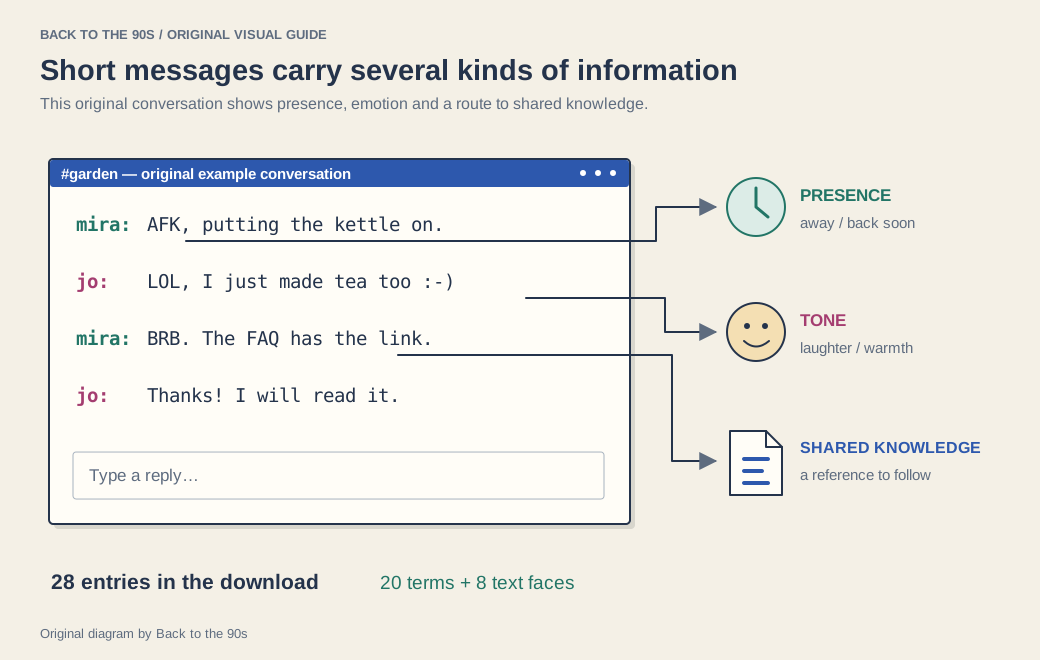
A short expression can report presence, soften a message or point towards a community reference.
Presence: arriving, leaving and coming back
A chat window can stay open while its owner does something else. Presence abbreviations explain that gap:
| Term | Meaning | Original example |
|---|---|---|
| AFK | Away from keyboard | “AFK — making tea.” |
| BRB | Be right back | “BRB, the kettle just clicked.” |
| BBL | Be back later | “BBL after dinner.” |
| WB | Welcome back | “WB! We saved your place.” |
| TTFN | Ta-ta for now | “TTFN — see you tomorrow.” |
Use BRB for a short interruption and BBL for a longer absence. WB welcomes someone back; it does not describe the sender’s own status.
DALnet’s IRC abbreviations guide, first written in June 2000 and revised that September, records these expressions alongside reaction and conversation terms. It gives us a dated example of the language in use within an actual chat network.
Reactions: laughter, play and acknowledgement
LOL expands to “laughing out loud”, while ROFL exaggerates the reaction into “rolling on the floor laughing”. In a short exchange, either can also help establish a light tone. Read the surrounding conversation to judge the emphasis.
JK means “just kidding”. NP, or “no problem”, often answers thanks. A compact exchange might look like this:
Alex: I finally fixed the link. Moss: The secret was spelling the filename correctly? Alex: A revolutionary technique. LOL Moss: Thanks for updating it. Alex: NP!
This conversation is an original example.
Conversation: introducing and qualifying an idea
| Term | Meaning | Typical job |
|---|---|---|
| BTW | By the way | Introduce a related thought |
| IMO | In my opinion | Mark a personal judgement |
| IMHO | In my humble opinion | Soften or play with an opinion marker |
| IRL | In real life | Refer to life outside the current online setting |
| ATM | At the moment | Describe a current state |
| OIC | Oh, I see | Acknowledge an explanation |
| LTNS | Long time no see | Greet someone after an absence |
The Internet Users’ Glossary, RFC 1983, includes IMHO in its August 1996 vocabulary.
Community words: learning the room
A FAQ gathers frequently asked questions. A handle identifies someone within a community. To lurk means to read without posting; it can give a newcomer time to understand the group’s subjects and habits. A flame describes a hostile or heated message, and a flame war extends that exchange across several replies.
These words make more sense when you know the setting. A forum has threads and returning readers; IRC has channels and an ongoing stream; instant messaging centers the contact list. Explore 90s forums and IRC chat rooms for those different social structures.
Text faces: turn punctuation sideways
| Face | Common reading |
|---|---|
:-) or :) |
A smile or friendly tone |
;-) |
A wink |
:-( |
Sadness or displeasure |
:D |
A broad grin |
:P |
A playful tongue-out expression |
:-O |
Surprise |
<3 |
A heart |
Scott Fahlman’s account describes proposing the sideways smile and frown on Carnegie Mellon’s bulletin board in 1982. His explanation centers on a practical problem: readers needed help recognizing jokes in text. In the original proposal, the frown marked serious messages; the table gives its later common reading.
By October 1995, RFC 1855’s netiquette guidance discussed smileys as tone markers alongside mixed case, emphasis and considerate replies. Our emoticon history follows that wider story.
Use the text-face category in the downloadable reference to compare the expressions. Add a short sentence beside a face when clarity matters; the words and punctuation can work together.