Y2K computer bug: the two-digit date problem explained
Published
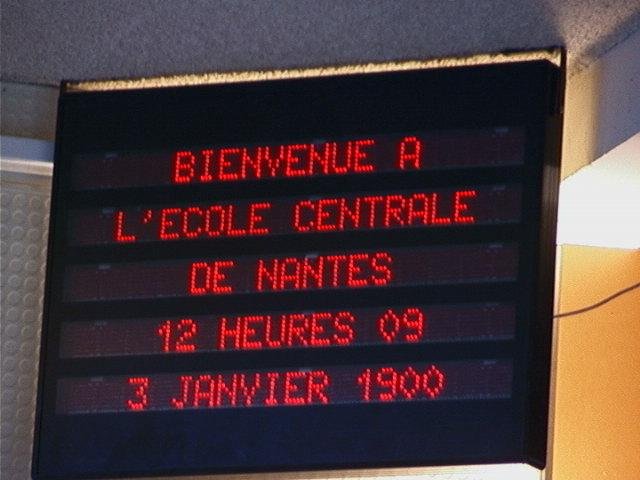
The Y2K bug was a date problem in software. Some programs stored only a year’s last two digits and assumed which century it belonged to. At midnight between 1999 and 2000, 99 became 00. A program could read the new year as 1900, put dates in the wrong order or work out the wrong gap between them.
On this page
Programs use dates to sort records, work out how much time has passed, decide who qualifies for a service and plan future work. Before 2000, teams checked those date rules, fixed affected programs and tested whether linked systems still worked together.
See the problem with two numbers
Take the year numbers 1999 and 2000. Subtracting the first from the second gives one. Keep only the final two digits, and the same-looking operation becomes 00 − 99, which gives negative ninety-nine.
Another program might read 00 as 1900 and place a new record a hundred years too early. The error depends on the program’s rules and what it is trying to do.
Open the original year-number demonstration and compare two-digit and four-digit subtraction. Try 1997 to 1999, then 1999 to 2000. The first pair stays within one century; the second crosses into a new century.
Why two digits existed
An April 1998 report from the US Government Accountability Office (GAO) describes the problem. It also explains the risks when systems shared dates. Early computers had little room to store data. Two-digit years saved space, and later software kept using them.
Many programs could depend on the same date format. One stored a date, another read it and a third used it to work something out. Changing how the first program stored the year meant checking all three.
Why changing the clock was not enough
A system for tracking inspections might store the year of the last service. It could work out how much time had passed and send the next due date to another program. Fixing the year shown on screen would not fix a wrong stored date or result sent elsewhere.
Teams therefore had to follow the date through input → storage → calculation → exchange → output. The same short year could pass through several programs.
The work had several stages
Teams first listed key systems and the dates they used. They looked for rules that would fail at the century change. They then fixed, replaced or stopped using the affected parts. Tests checked both the results and the links between systems.
Tests could use dates before and after 2000, older records and data sent by another organization. Teams also made backup plans to keep key work going if something failed.
The 1998 GAO report says organizations had to work together because they shared dates. A fixed program still needed to read the dates sent by another system.
What happened when 2000 began
GAO’s 2022 review says preparation helped the United States avoid major national failures at the century change. It credits Congress, the Office of Management and Budget and federal agencies. GAO took the Y2K problem off its high-risk list in 2001.
The share of key systems ready for 2000 rose from 21% in May 1997 to 99.9% in December 1999. These figures cover 24 major federal departments and agencies. Most reported federal errors at the century change were minor. Fixes or backup plans dealt with the larger problems.
Y2K as a computing event and a design label
The bug concerns dates inside software. The Y2K aesthetic guide explores the chrome, see-through color and pictures of imagined futures around the year 2000.