What is the IndieWeb movement?
Published
The IndieWeb is a community of people building and using personal websites with more control over their online identity and data. A site can be a home for writing, photos or links even when its owner also uses social platforms.
What makes it a movement?
IndieWebCamp co-founder Aaron Parecki describes owning your domain and data as an IndieWeb principle. That gives a site an address its owner can keep when changing hosts, provided they retain the domain. The movement also develops ways for independent sites to communicate. A retro design is optional.
How can sites talk to each other?
Webmention is a web standard for notifying a site when another page links to it. A receiving site can use such notifications for replies or other interactions, if its software supports them. The IndieWeb community contributed the specification to the W3C; it became a W3C Recommendation in 2017.
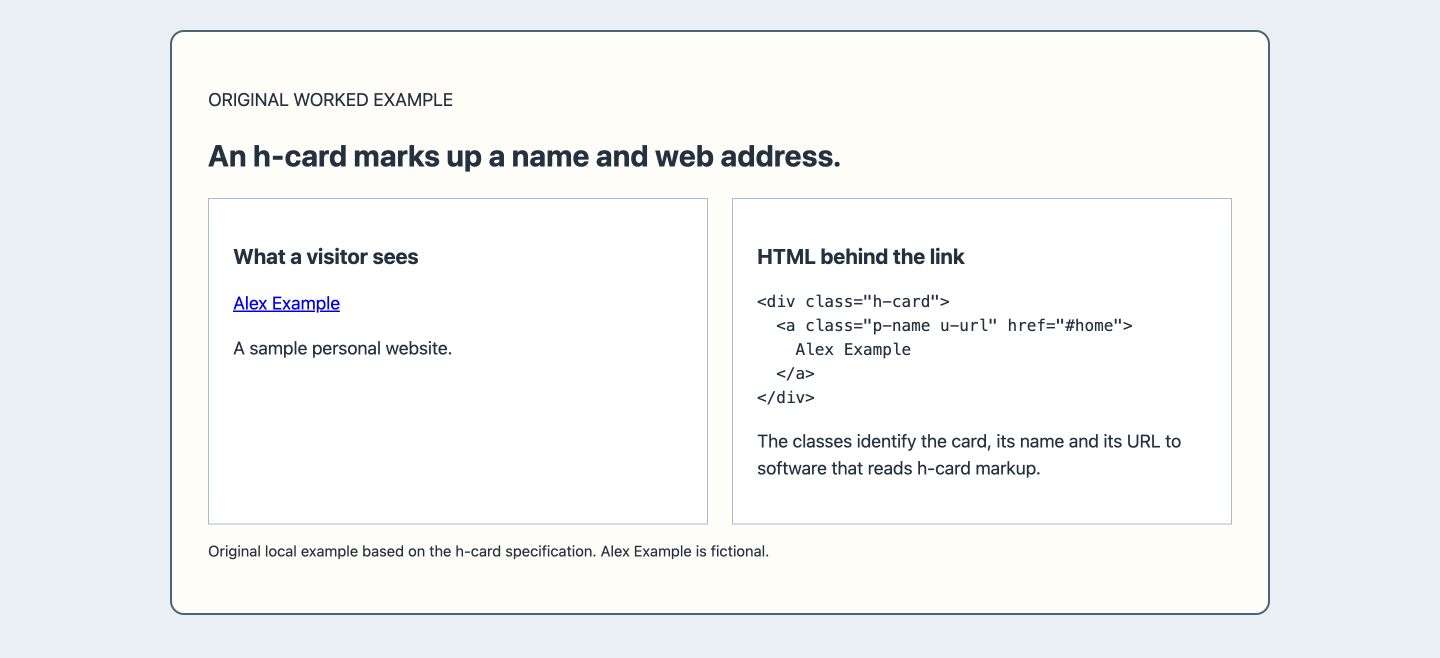
h-card adds labels to a page’s HTML, the code used to build a web page. Those labels identify details such as a person’s name and website address, so compatible software can recognise them as a profile rather than ordinary text. Neither h-card nor Webmention is required just to publish a personal page.
Where to begin
- Make a page about something you care about and publish it with a host you understand.
- Consider a domain you control if you want an address independent of the host. Check its registration and renewal costs first.
- Link to other sites you enjoy. If you want to receive notifications when other sites link to yours, check whether your site software supports Webmention. If you want compatible software to recognise your name and website address, look into adding an h-card.
Our small-web guide covers finding and making personal sites. The IndieWeb adds a community and shared publishing practices to that broader subject.